
Can a 2.6B parameter model outperform models ten to thirty times its size?
Can a 2.6B parameter model outperform models ten to thirty times its size?
I analysed 300 open-weight model families from Artificial Analysis (all data using the Artificial Analysis API). MiniCPM5-2B, an open-weight 2.6B dense model, scored 14.3 on the overall Intelligence Index. That score puts it ahead of 100% of tiny models under 5B, 90.4% of small models (5B to 27B), and 94.3% of medium models (28B to 124B). It also beats 40.2% of large models over 124B.
Looking across individual capability benchmarks in the chart below shows where it excels and where parameter limits still matter:
- Tool Calling (tauBanking): Scores 20.8%. It beats 84.0% of small models, 91.7% of medium models, and 57.8% of large models on multi-turn workflows.
- Long-Context Reasoning (LCR): Scores 59.3%. It beats 82.2% of small models and 85.7% of medium models.
- Scientific Reasoning (GPQA): Scores 70.2%. It outperforms 76.8% of small models and 66.7% of medium models.
- Physical Limits (SciCode and TerminalBench): On complex scientific coding and terminal tasks, it beats only 12.5% and 21.4% of medium models.
For edge hardware and local setups, you can now run tool-calling and structured reasoning on a laptop that previously required a server cluster or a 70B model. Even the MiniCPM5-1B variant looks very promising.
MiniCPM is one of several models outperforming its size class. The interactive dashboard covers the full evaluation of 300 model families across four size tiers. It includes:
- Tier-defying standouts like Qwen3.8 27B, which scores 33.9 on the Intelligence Index and beats 90.2% of models over 124B.
- Parameter efficiency leaders like Ling 3.0 Tiny (1.3B active parameters) and Qwen3.6 35B A3B (3.0B active parameters).
- Scorecards tracking smaller models that beat 70B and 400B models.
- Active parameter efficiency rankings across dense and MoE architectures.
You can explore the interactive charts, tier distributions, and full scorecard here: https://hari31416.github.io/open-source-models-and-MiniCPM5/

MiniCPM5-2B (2.6B) Capability Scorecard showing the percentage of models beaten across Tiny, Small, Medium, and Large parameter tiers.
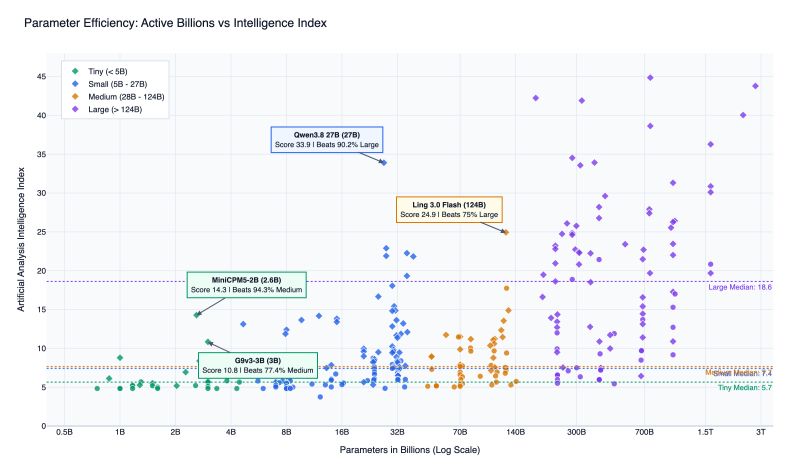
Parameter efficiency distribution: Active parameter count (in billions, log scale) versus Artificial Analysis Intelligence Index score across 300 open-weight model families.